Organizing a friendly moment with family or friends requires neither expensive equipment nor complex planning. The formats of entertainment are evolving, driven by a growing demand for intergenerational games and activities that involve everyone, from the youngest to the oldest. This article explores several concrete ideas for animating these shared moments, taking into account real constraints: available space, ages of participants, budget, and even regulations when the event scales up.
Intergenerational Games: Creating an Activity Where No One Is a Spectator
The main challenge of family or mixed group entertainment is the skill gap between participants. A game that is too physical excludes grandparents, while a quiz that is too specialized bores children. Leisure professionals observe a rise in formats designed to mix multiple generations, particularly in escape rooms and indoor complexes.
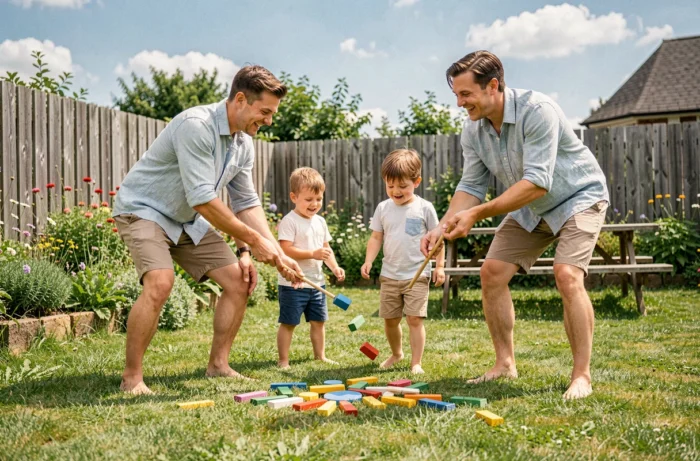
The principle that works is based on a common goal rather than direct competition. A treasure hunt in the garden, for example, can assign different roles based on age: the youngest look for visual clues, teenagers decipher riddles, and adults coordinate. Each participant contributes according to their abilities, not their level.
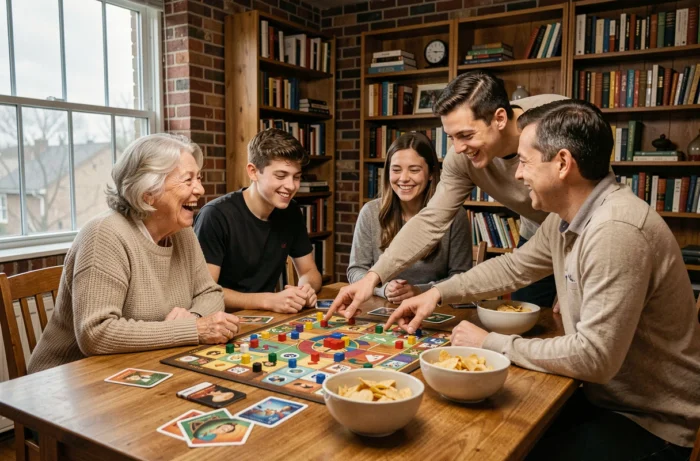
This logic is found in cooperative board games, where the entire group wins or loses together. Catalogs and specialized sites like pcommeplimplim.com offer resources tailored to this type of configuration, designed for groups of varying ages.

Creative Group Activities: What Works Beyond Classic Crafts
Creative workshops appear on all idea lists, but their success depends on a parameter rarely mentioned: the level of autonomy that the activity grants to each participant. A free painting workshop works because no one has to wait their turn. A pottery workshop, on the other hand, can be frustrating if materials are limited.
Three creative formats are particularly well-suited for heterogeneous groups:
- Collaborative collage on a large surface (paper tablecloth, recycled cardboard): everyone contributes at their own pace with magazines, fabric, and markers. No strict instructions, no failed results.
- Temporary chalk mural on an exterior wall or on the ground. The gesture is accessible from three or four years old, and adults find a space for graphic expression without pressure.
- Creating a collective object (cardboard hut, mobile, garland) with a division of tasks: cutting, assembling, decorating. The final result belongs to the group.
The common point of these three proposals: none require a significant investment, and all produce a visible result at the end of the session. This tangible aspect matters, especially for children.
Home Quizzes and Escape Games: Transforming Your Living Room into a Playground
The family quiz remains one of the simplest formats to set up. About twenty questions are enough to occupy a good half-hour. The key lies in the mix: combining categories (general knowledge, family memories, visual riddles) allows each age group to shine on at least one topic.
The home escape game requires more preparation, but the effect is proportional to the effort. You can start with a simple scenario (finding a hidden object, opening a locked chest) and scatter clues in several rooms. Ready-to-use kits are available for those who prefer not to invent everything.
Adapting Difficulty Without Excluding
For a group mixing children and adults, it is relevant to create two levels of clues: a visual circuit (drawings, colors, objects to spot) and a textual circuit (charades, codes, rebuses). Mixed teams composed of one adult and one child work better than homogeneous teams because they require communication.
Board Game Night: Beyond Monopoly
The French toy and game market has shown strong dynamics in recent years. This vitality translates into a constant renewal of available references, with increasingly varied game mechanics. Cooperative games and short-rule party games dominate sales for group evenings.
For a successful evening with friends or family, the choice of game sets the mood. A light role-playing game (like Werewolf) creates verbal interaction. A speed or charades game provokes laughter. A strategy game is better suited for a small, focused group.
The duration of the game matters as much as the game itself. Beyond 45 minutes, the attention of younger players wanes. It’s better to play two short games than one long game that drags on.
Safety and Common Sense: Points to Check When the Event Grows
When a family activity exceeds the confines of the living room (party in a garden, birthday under a tent, neighborhood fair), practical questions arise. A tent or marquee hosting at least 50 people may come with specific obligations: structure approval, safety register, declaration at the town hall.
Noise protection is another issue often overlooked. During events with amplified music or a crowd of young children, recent recommendations emphasize the importance of planning a quiet area away from the speakers. This type of precaution costs nothing and prevents early departures from families with very young children.
In terms of civil liability, insurance may be necessary once the event is open to the public or organized in a shared space. Feedback from the field varies on the exact threshold, but the reflex to check with the town hall remains the best approach.
Ultimately, animating a moment with family or friends relies on a simple arbitration: choose an activity that allows space for everyone rather than a spectacular activity that only suits part of the group. Cooperative formats, open creative workshops, and short-rule games share this quality. The rest is a matter of context, space, and the mood of the moment.