
You have been in the car for twenty minutes and nausea is already rising. Your vision blurs, your hands become clammy, and the journey turns into a nightmare. This scenario affects a significant portion of travelers, both adults and children, whether in a car, on a boat, or in an airplane.
Motion sickness, the medical term for travel sickness, results from a conflict between the information sent by the inner ear and that perceived by the eyes. The P6 point, derived from traditional Chinese medicine, offers a solution through simple finger pressure on the forearm. No medication, no drowsiness: just a precise gesture to know before hitting the road.
Sensorial conflict and nausea: what really happens in the body
Before discussing the P6 point, it is essential to understand why the body reacts so poorly to movement. Three systems inform the brain of your position: the inner ear (which detects accelerations and rotations), the eyes, and the receptors located in the muscles and joints.
When you read a book in the car, your eyes signal stillness. Your inner ear, however, perceives every turn and every brake. The brain receives conflicting signals and triggers nausea, cold sweats, and vomiting. This is a defense mechanism, not a disease per se.
This sensorial conflict also explains why the driver is rarely sick: their eyes follow the road and confirm what the inner ear perceives. The passenger who stares at their phone, on the other hand, deprives their brain of this visual coherence. Understanding this mechanism helps to grasp why certain approaches, such as the stimulation of the P6 point in medicine against motion sickness, target nausea rather than dizziness itself.

Location of the P6 point on the forearm: practical markers
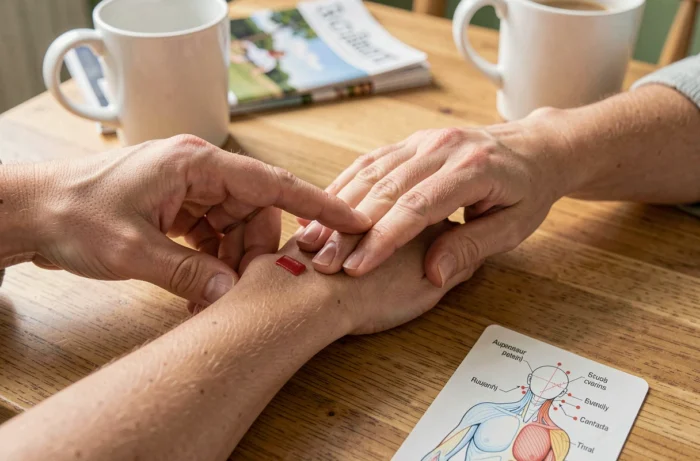
The P6 point, also known as Neiguan in Chinese nomenclature, is located on the inner side of the forearm. To locate it, place three fingers (index, middle, ring) across the wrist, just above the flexion crease. The P6 point is located beneath the edge of the index finger, between the two tendons that you feel when you slightly contract your wrist.
These two tendons are the palmaris longus and the flexor carpi radialis. The point is in the hollow between them, not on a tendon. If you press in the right spot, you will feel slight tenderness, sometimes a subtle numbness radiating towards the palm.
Effective pressure technique
Press with the thumb of the opposite hand, perpendicular to the forearm. The pressure should be firm without being painful. Hold for two to three minutes, then release and repeat on the other wrist.
- Make small slow circular movements rather than static pressure, as this facilitates stimulation of the area
- Start the stimulation before departure (as a preventive measure) rather than during a full-blown nausea attack
- Repeat the operation every fifteen to twenty minutes if symptoms persist during the journey
The regularity of the pressure matters more than its intensity. Too much pressure creates pain that distracts attention without improving the outcome.
Acupressure bracelets and the P6 point: what the data says
The anti-nausea bracelets sold in pharmacies are based on the same principle: a plastic bead exerts continuous pressure on the P6 point. The concept is appealing, but the evidence deserves a nuanced look.
The strongest trials concern postoperative nausea, not motion sickness. Several literature reviews report a measurable benefit from P6 stimulation after general anesthesia. For motion sickness specifically, results vary more from one study to another.
A point often overlooked: some trials comparing real bracelets to placebo bracelets (misplaced bead) do not always find a clear difference. The placebo effect plays a significant role, which does not mean the bracelet is useless. It means that P6 stimulation likely acts on nausea but does not eliminate sensitivity to motion.
Bracelet or manual pressure: what to choose in a car or on a boat
Manual pressure offers an advantage: you control the exact location and intensity. The bracelet, on the other hand, frees your hands and is better suited for children who won’t maintain self-stimulation during a long trip.
For a boat trip where movements are large and prolonged, the bracelet ensures continuous stimulation. In a car, on shorter trips, targeted manual pressure before and during the journey may suffice.
Combining the P6 point with other natural solutions against nausea
P6 stimulation works best as a complement rather than a standalone solution. A few coherent combinations enhance its effect.
- Fresh ginger or ginger capsules, consumed about thirty minutes before departure, act on nausea through a different pathway (action on digestive receptors)
- Significant peppermint oil, inhaled on a tissue, reduces the nauseous sensation in some people sensitive to smells
- Fixing your gaze on the horizon or a stable point through the windshield restores coherence between vision and inner ear
However, the P6 point does not replace medication treatment when motion sickness is severe. Antihistamines remain the reference for people who systematically vomit in cars or planes. Acupressure can then serve as support, not substitution.
For children, for whom some medications are contraindicated or cause marked drowsiness, the combination of the P6 bracelet and ginger is a gentle alternative to test on a short trip before adopting it for long journeys.
The P6 point will not turn a passenger prone to seasickness into a seasoned sailor. This simple, free gesture with no side effects deserves its place in the travel kit, provided it is considered for what it is: a tool among others, effective especially on the nauseous component of motion sickness, and all the more useful when practiced early, before symptoms set in.