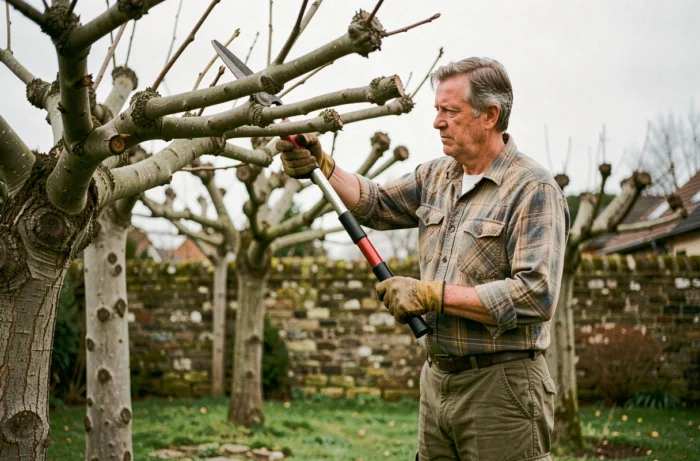
The plane tree mulberry (Morus kagayamae) grows quickly, and its branches spread in all directions from the second year. Without regular pruning, the tree loses its parasol shape and becomes difficult to manage. Pruning a plane tree mulberry does not require landscaping expertise, but a few precise actions make the difference between a well-structured tree and a tangle of dead wood.
Healing of the plane tree mulberry: what conditions each cut
Before discussing timing or shape, it is essential to understand how this tree reacts to wounds. The plane tree mulberry heals slowly on cuts of large diameter. A branch cut flush with the trunk without caution leaves an open wound, exposed to wood-decaying fungi.
Specifically, if you cut a branch the size of your wrist, the tree will take several seasons to close the wound. In contrast, branches less than two centimeters heal in a few weeks. The entire pruning strategy stems from this observation: it is better to intervene often on small wood than rarely on large wood.
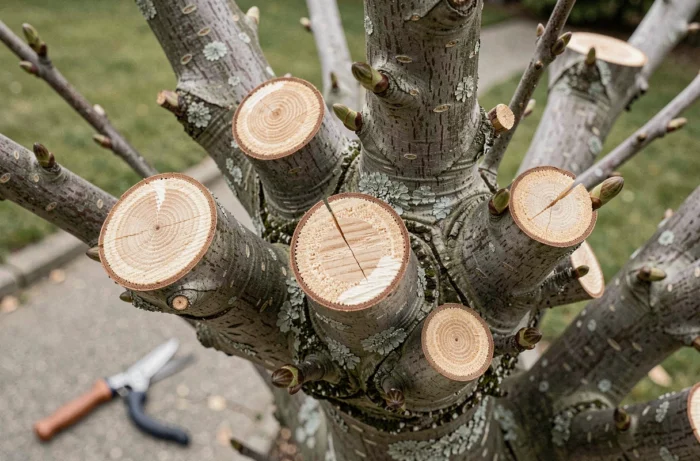
The callus, this visible swelling at the base of each branch, must remain intact. Cut just beyond it, a few millimeters away. If you cut into the callus, healing is compromised. If you leave a stub of several centimeters, the dead wood becomes an entry point for pests.
As detailed in the articles from Jardiner Naturellement, the quality of each cut matters more than the number of branches removed.
Pruning the plane tree mulberry and nesting: the timing constraint to respect
Most guides recommend pruning in winter, between November and February. This remains valid. The tree is dormant, the sap has descended, and the leaves have fallen: you can see the structure of the branches.
But a rarely mentioned point changes the practical situation. Any significant pruning is discouraged between mid-March and the end of July to protect bird nesting. This recommendation, echoed in 2025-2026 by media such as Ouest-France Immo and Pleine Vie, also applies to individuals.
The parasol-shaped plane tree mulberry produces dense foliage that attracts nesting passerines. Intervening during the peak breeding season potentially destroys active nests, even if you do not see them.
In practice, you have two pruning windows:
- From November to the end of February for structural pruning, where you remove poorly oriented branches and rebalance the silhouette.
- From late August to mid-October for light cleaning, removing broken branches or vertical shoots (suckers) that unbalance the crown.
Avoid pruning from March to July, even for a simple shortening. A month of patience protects wildlife and avoids stressing the tree during the sap rise.
Tools and techniques for pruning a parasol plane tree mulberry
You may have noticed that some plane tree mulberries look like a regular mushroom, while others spread in all directions? The difference lies in the consistency of interventions and the choice of branches removed.
Selecting branches to cut
The principle is simple: keep branches that grow horizontally or slightly sloping, and remove those that grow straight up towards the sky. Vertical branches (suckers) capture all the tree’s energy at the expense of the parasol shape.
Also remove branches that grow inward towards the crown. They cross, rub against each other, and create shaded areas where air circulation is poor. This aeration of the center prevents fungal diseases.
Tools suitable for the diameter of branches
Three tools are sufficient for almost all situations:
- A bypass pruner for thin shoots, up to two centimeters in diameter. Avoid anvil pruners that crush the wood instead of cutting it.
- A lopper for sections from two to five centimeters. The lever arm reduces effort, and the cut remains clean.
- A pruning saw for thicker branches. Use the three-step cutting technique: a notch under the branch, then a cut from above a bit further out, and finally the removal of the stub flush with the callus.
Disinfect the blades with alcohol between each tree, and ideally between each large cut. The plane tree mulberry is sensitive to certain bacterial diseases that can be transmitted by tools.
Should you apply healing paste?
This question often arises. For small diameter cuts, it is unnecessary: the tree manages on its own. For cuts larger than five centimeters, opinions vary among arborists. Some pastes trap moisture and promote rot rather than prevent it.
The best protection remains a clean cut, in the right place and at the right time. If you prune in winter on dry wood, the risk of infection is low.
Common mistakes that permanently damage a plane tree mulberry
Pruning too severely at once is the most common mistake. A neglected plane tree mulberry for several years develops large diameter branches that one is tempted to cut radically. The result: the tree produces an explosion of suckers the following year, even more vigorous and disordered than before.
If your tree has been left unmaintained, spread the recovery over two or three winters. In the first year, remove dead wood and crossing branches. In the second year, shorten the excessively long branches. In the third, refine the silhouette.
Another trap: cutting all branches to the same length, like a hedge. The plane tree mulberry is not a shrub trimmed to a line. Each branch should be cut above a bud oriented outward, which gives a natural flared crown.
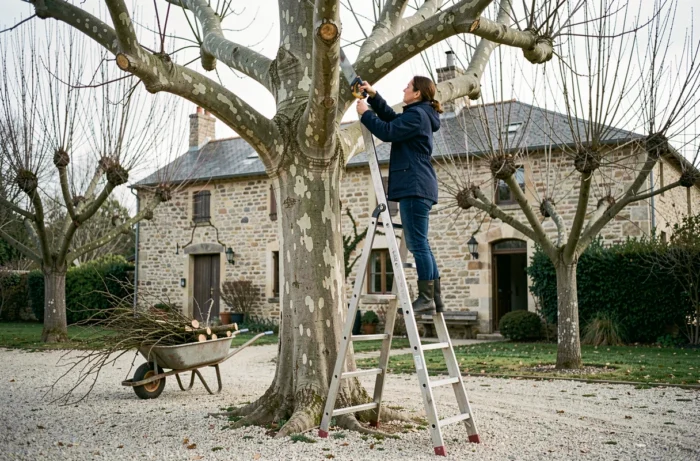
A well-pruned plane tree mulberry is recognized by its airy branching and the absence of visible stubs. Two targeted and moderate interventions per year are sufficient to maintain this parasol silhouette that gives the tree its charm in a garden.