The choice of a tree to plant near a house relies less on aesthetics and more on the compatibility between the root system, the nature of the soil, and the distance to the building. A poor match between these three parameters can result in cracks, blocked pipes, or excessive shade on living spaces.
Clay soil and shrink-swell: the parameter that most guides underestimate
Before consulting a species catalog, we recommend checking the exposure of the plot to shrink-swell clays on the Géorisques map (operated by the BRGM). In medium or high risk areas, the roots of a tree that consumes a lot of water exacerbate the hydric variations of the land, which worsens soil movement and structural cracks after dry periods.
Species with strong root development and high evapotranspiration (poplars, willows, certain oaks) should be avoided or set back well beyond the usual distances. In clay soil, the empirical rule of keeping the tree at least its adult height away makes perfect technical sense.
On well-draining sandy or loamy soil, the constraint is less severe. The type of soil thus conditions the list of candidate species even before discussing flowering or foliage. You can also find Perspectives Jardin’s advice for trees that detail suitable species according to the terrain configuration.
Roots and pipes: assessing the condition of the buried network
The invasive reputation of certain roots does not tell the whole story. Roots primarily penetrate already weakened pipes: defective joints, cracked pipes, poorly sealed connections. A recent and properly installed PVC network withstands much better than an aging asbestos-cement network, regardless of the species planted nearby.
We regularly observe damages wrongly attributed to a maple or a linden, while the real issue is a sewage collector predating the 1980s. Before planting, running an inspection camera through the pipes near the future location helps clarify the ambiguity.
If the network is healthy, species with moderate but spreading roots (such as the fastigiate hornbeam or ornamental cherry) can be planted a few meters from the building without real risk. If the network is degraded, even a reputedly wise tree will pose problems in the long term.
Legal planting distance: what Article 671 of the Civil Code really says
Article 671 of the Civil Code establishes a minimum distance of 2 m from the property line for plantings that may exceed 2 m in height, and 50 cm for those that will remain below. This distance is measured from the boundary line, not from the wall of the house.
A municipal PLU, a subdivision regulation, or local usage may modify these thresholds. Consulting the town’s urban planning department is a non-negotiable prerequisite, especially in a co-ownership or recent subdivision where the rules are often more restrictive.
If a branch or root encroaches on the neighbor’s property, they can demand trimming or removal of what encroaches. This right is imprescriptible. Planting a large-growing tree at the allowed limit remains legally risky, even if the legal distance is respected.
Species to prioritize based on adult size and desired use
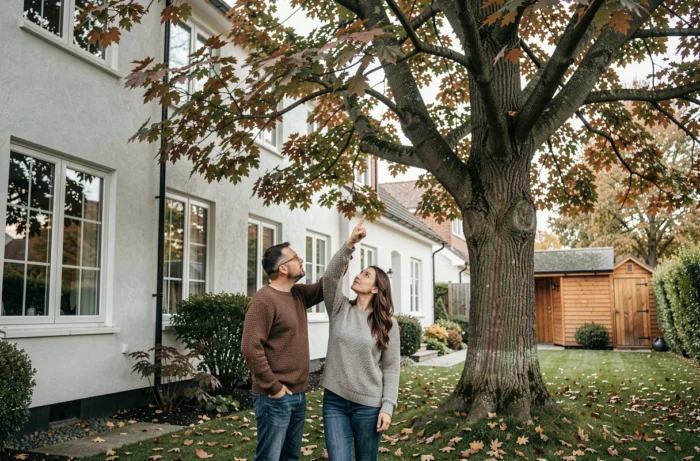
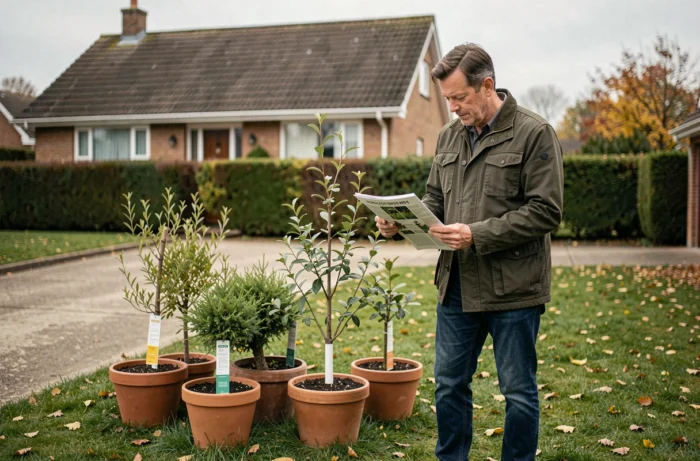
The determining criterion remains the actual adult size of the tree, not the size indicated on the nursery label (which is often optimistic). A field maple commonly reaches around ten meters in favorable conditions. A magnolia grandiflora can far exceed expectations if the soil suits it.
For a restricted space less than 4 m from the building
- Japanese maple (Acer palmatum): shallow and non-aggressive rooting, controlled adult height, deciduous foliage that limits winter shade. Requires cool, acidic to neutral soil, and semi-shaded exposure.
- Flowering cherry (Prunus serrulata): spectacular flowering in spring, compact growth, shallow roots. Shorter lifespan than a typical deciduous tree, to be considered in planning.
- Judas tree (Cercis siliquastrum): pink flowering directly on the wood, good tolerance to summer drought, moderate growth. Taproots that penetrate vertically rather than laterally.
For a larger garden with sufficient setback
- Hornbeam (Carpinus betulus): marcescent foliage that retains some leaves in winter, providing natural screening. Non-aggressive roots for a tree of this size. Prunes well.
- Linden with small leaves (Tilia cordata): generous shade, fragrant flowering in June, good adaptation to calcareous soils. To be planted at a respectful distance from terraces (the honeydew from linden aphids is a recurring nuisance).
- Field maple (Acer campestre): hardy, low soil requirements, moderate growth. Naturally rounded shape that requires little formative pruning.
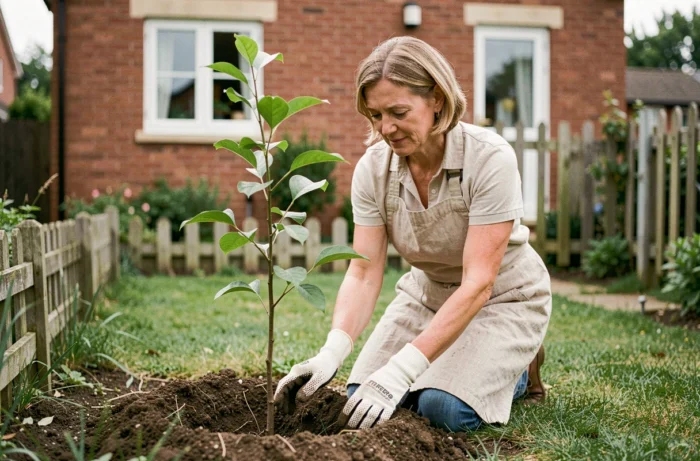
Fruit trees (apple, pear, cherry) are often an underutilized alternative. Grafted onto dwarfing rootstocks, they remain compact and their root system stays proportionate. The dropping of fruits requires regular maintenance of the soil at the base of the tree.
Shade and orientation: anticipating the impact on thermal comfort
A deciduous tree planted to the south or southwest of the house provides natural sun protection in summer while allowing light to pass in winter. This positioning significantly reduces air conditioning needs without penalizing winter sunlight.
In contrast, an evergreen (magnolia, holm oak, laurel) placed in the same spot will plunge the rooms into shadow all year round. Evergreens find a better place to the north or as a lateral windbreak, where their permanent foliage protects against cold drafts without blocking useful light.
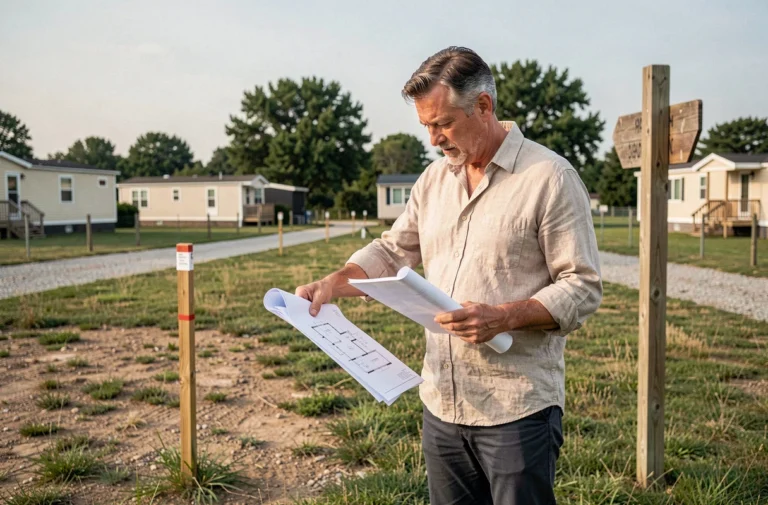
Projecting the shadow cast by the adult tree onto a plan of the house, taking into account the sun’s path in summer and winter, avoids unpleasant surprises a decade after planting. It’s a simple exercise that radically changes the relevance of the final choice.
The best tree near a house is not the prettiest in the catalog. It is the one whose root system is compatible with the existing soil, whose adult size respects the distances to the building and property lines, and whose shape corresponds to the orientation of the concerned facade. Three technical constraints, not three aesthetic preferences.