When you want to steam vegetables or keep bread soft in the center, the reflex might be to buy a dedicated steam oven. The problem is that most kitchens are already equipped with a conventional oven that works very well for everything else.
The good news: you can adapt this existing oven to achieve proper steam cooking without investing in an additional appliance. However, you need to understand what actually happens inside the oven when you introduce moisture.
What distinguishes supplemental steam from true steam cooking
Before placing a container of water in your oven, it’s important to understand a distinction that manufacturers themselves make vague. Many so-called “steam” appliances only inject a bit of moisture into the cavity, never reaching a true steam cooking environment.
A dedicated steam oven generates steam continuously thanks to a separate reservoir and heating system. A conventional oven rigged with a dish of hot water produces a much lower and, above all, irregular humidity level.
In practice, supplemental steam is sufficient for certain preparations: improving the crust of bread, preventing a cake from drying out on the surface, or reheating a dish without turning it into cardboard. However, for cooking a fillet of fish or broccoli solely with steam, the result remains below what you would achieve with a device designed for that.
You can explore different steam cooking methods in the oven to identify the one that suits your equipment and your usual recipes.
Water tray, baking sheet, and ice cubes: which technique to choose in the oven
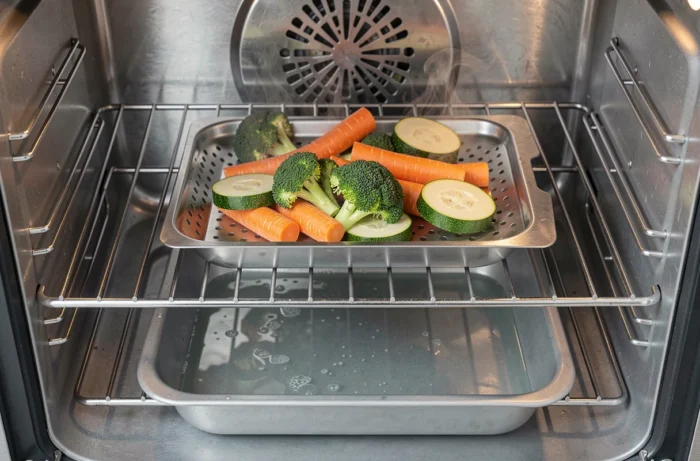
The most common method involves sliding a container filled with boiling water onto the oven floor or the lower rack. The water evaporates due to the heat and creates a humid environment inside. Simple, but with limitations: the water temperature drops quickly, and steam production decreases as cooking progresses.
The preheated baking sheet with boiling water
You preheat the baking sheet in the oven, then pour boiling water just before placing the dish inside. The thermal shock causes an intense release of steam during the first few minutes. This is the reference technique for homemade bread: the initial steam promotes crust development before it sets.
Ice cubes on the oven floor
Some amateur bakers prefer to throw a handful of ice cubes directly onto the hot baking sheet. The principle is the same, but the gradual melting of the ice cubes slightly prolongs the steam production duration. Feedback varies on this point: depending on the oven and its sealing, the gain can be negligible or truly noticeable.
Water spray on the walls
Spraying water on the interior walls of the oven with a spray bottle creates a quick flash of steam. You can combine this technique with a dish of water to maintain humidity longer. Be careful not to spray the heating element or the glass, as they may react poorly to the thermal shock.
- The preheated baking sheet is suitable for breads and pastries that need a strong and brief initial steam burst.
- The dish of water placed on the lower rack works better for long and gentle cooking (poultry, root vegetables) where you want to maintain humidity inside.
- The spray is a temporary supplement, not a standalone solution: it helps for the first five minutes of cooking.
Accessories for steam cooking in the oven: what really changes the result
Beyond the simple dish of water, a few accessories transform the experience. The most accessible is the foldable stainless steel steamer basket, which fits into a saucepan or Dutch oven suitable for the oven. You fill the bottom with water, place the basket on top, cover it, and put it in the oven. This system creates a closed steam micro-environment, much more effective than free steam in the oven cavity.
Cast iron pots with lids work on the same principle. The moisture released by the food remains trapped inside. For bread, cooking under a cast iron lid replicates the conditions of a baker’s oven surprisingly faithfully.
There are also intermediate solutions. Compact “steam-bake” devices are starting to spread in the consumer market. These countertop ovens offer humidity control, rapid preheating, and combined steam and convection modes. For those who regularly cook with steam without wanting to replace their built-in oven, it’s a viable compromise.
Temperature and heating mode: the settings that matter
Introducing steam into a conventional oven does not exempt you from considering the heat setting. The combination of steam and high temperature does not have the same effect as steam and low temperature.
For bread, you start strong (around the maximum oven temperature) with maximum steam for the first ten minutes, then remove the water container to let the crust dry and harden. Removing the steam source halfway through cooking is as crucial as adding it at the start.
For vegetables or fish, you work at moderate temperature. Convection helps distribute humidity more evenly in the cavity. The natural convection mode (without a fan) tends to concentrate steam at the bottom of the oven, which can create cooking discrepancies between racks.
- Bread and pastries: maximum temperature, intense steam for the first ten minutes, then dry cooking.
- Fish and vegetables: moderate temperature with convection, water dish maintained throughout the cooking duration.
- Roasting meats: a bit of water in the baking sheet keeps the texture moist without preventing the formation of a beautiful golden crust at the end of cooking.
A conventional oven will never become a true steam oven. The door’s sealing, the lack of a dedicated generator, and the difficulty in controlling humidity levels limit the results.
With the right techniques and a minimum of equipment, you can still achieve much softer cooking and breads with a crust that cracks just right. The most effective method remains cooking under a lid (cast iron pot or bread dome), which traps steam directly around the food.