A colleague sending a message at 10 PM, a notification waking you up at 3 AM, a commute where you scroll aimlessly: daily stress rarely sets in all at once. It accumulates in micro-doses, often linked to habits we no longer question. Regaining calm and well-being in daily life comes less from grand resolutions than from concrete, repeated adjustments on specific points.
Smartphone and Sleep: The First Lever for Daily Calm
We start here because it’s the most underestimated point. According to an OpinionWay survey for INSV published in 2026, 58% of French people sleep with their smartphone turned on next to them. Nearly a quarter are awakened at night by notifications.
The link between this habit and the level of stress felt the next day is direct. Fragmented sleep prevents the brain from properly processing the emotions accumulated throughout the day. We wake up already in debt, and the slightest annoyance takes on disproportionate proportions.
The simplest, and probably the most effective, tip is to remove the phone from the bedroom. Not in airplane mode on the nightstand: in another room, with a traditional alarm clock instead. INSEE already reported in 2024 that a quarter of internet users aged 15 to 74 voluntarily reduce their sleep to spend more time in front of a screen. We can reverse this trend without any particular effort, just by changing the location of one object.
Resources like tranquillitesante.fr allow for a deeper exploration of these health and serenity issues in daily life, in addition to the practical adjustments described here.
Slow Breathing: A Relaxation Technique That Works in Minutes
When we talk about anti-stress breathing, we often think of meditation or complex exercises. In practice, the mechanism is simpler than that. Deliberately slowing the breathing rate activates the parasympathetic nervous system, the one that slows down stress reactions.
How to Practice Without Complicating Life
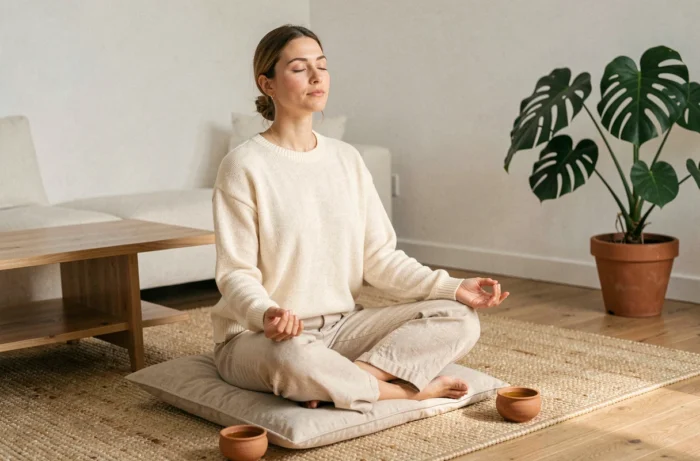
Breathe in through the nose for four to five seconds, and exhale through the mouth for six to eight seconds. The longer exhalation compared to inhalation is what makes the difference. No need to count perfectly: the idea is to lengthen the breath without forcing.
What makes this technique useful in daily life is that it works anywhere. In a meeting, on public transport, before falling asleep. Three to five minutes are enough to feel a decrease in physical tension. Feedback varies on the speed of the effect depending on the person, but the physiological mechanism is documented.
- Before a stressful situation (interview, difficult call): five slow cycles to lower the heart rate
- During a break in the day: a three-minute pause without screens, focused solely on the breath
- At bedtime: extended breathing while lying down, eyes closed, to facilitate falling asleep
Short Physical Movement Instead of Intensive Sports
Physical well-being is often associated with structured workout sessions. In reality, to impact daily stress, ten minutes of walking after a moment of tension is worth more than an hour in the gym three days later.
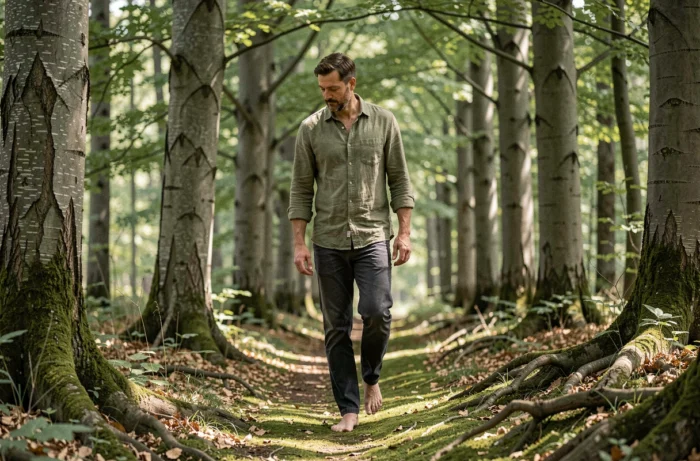
Walking, even briefly, reduces cortisol levels and changes mood in just a few minutes. After a tense exchange or a busy morning, stepping outside for a few minutes, ideally outdoors, breaks the cycle of mental rumination. The body moves, the mind disconnects.
Integrating Movement Without Planning
The classic trap: telling yourself you will “exercise tonight” and never doing it because fatigue takes over. A more realistic approach is to insert micro-movements into the day without scheduling them as an activity.
- Get off one stop early or park further away to walk five to ten minutes
- Stretch while standing every two hours, focusing on the shoulders and neck (chronic tension areas)
- Take the stairs instead of the elevator, even partially
It’s not spectacular. But the cumulative effect of these micro-physical activities on mood and vitality exceeds what we imagine, especially when they become automatic.
Consulting a Wellness Practitioner: A Common Approach
Individual tips have their limits. When stress settles in for the long term, one can go around in circles with their own tools without making progress. The 2026 Well-being Barometer (Resalib/SPBE) shows a clear shift: improving psychological state is the primary reason for consultation (58.5%), ahead of physical reasons (55.2%).
People no longer consult just for back pain or a migraine. They consult a sophrologist, a naturopath, or a relaxation practitioner because they sleep poorly, feel overwhelmed, or experience accumulating anxiety. This evolution reflects an awareness: natural therapies and structured relaxation practices complement daily adjustments effectively.
The benefit of support is regularity and an outside perspective. A practitioner identifies patterns that one may not see themselves, proposes exercises suited to their situation, and creates a framework where one allows themselves to slow down.
Regaining calm in daily life does not require a radical life change or a significant budget. A phone moved out of the bedroom, three minutes of conscious breathing, a few steps outside after a tense moment, and possibly an appointment with a practitioner when personal tools are no longer sufficient. These are modest gestures, but their repetition produces measurable effects on sleep, mind, and body.