
Vermogal is an anti-parasitic gel formulated to eliminate lice. Its composition is based on agents such as bioallethrin, benzododecinium bromide, and piperonyl butoxide. These substances target scalp parasites, not the hair fiber. Understanding this pharmacological nature is the starting point for any rational use of Vermogal on hair.
Composition of Vermogal and its actual effect on the hair fiber
Unlike traditional hair care products (coconut oil masks, keratin serums, brewer’s yeast), Vermogal contains no nourishing or restructuring active ingredients. Its active principles are insecticides and synergists designed to paralyze and then kill adult lice and nits.
The confusion arises from an empirical observation: after an anti-parasitic treatment, the scalp, free of its parasites, returns to a better overall condition. Itching stops, micro-lesions heal, and hair appears healthier. This renewed shine is linked to the disappearance of the parasitic problem, not to a cosmetic effect of the gel itself.
Detailed information on application methods is available in the guide dedicated to Vermogal for hair on Espace Forme et Beauté, which specifies precautions suitable for each type of scalp.
Vermogal is not a nourishing hair treatment: using it as such is akin to misusing an anti-parasitic medication from its primary function.
Vermogal and lice treatment: application protocol on the scalp
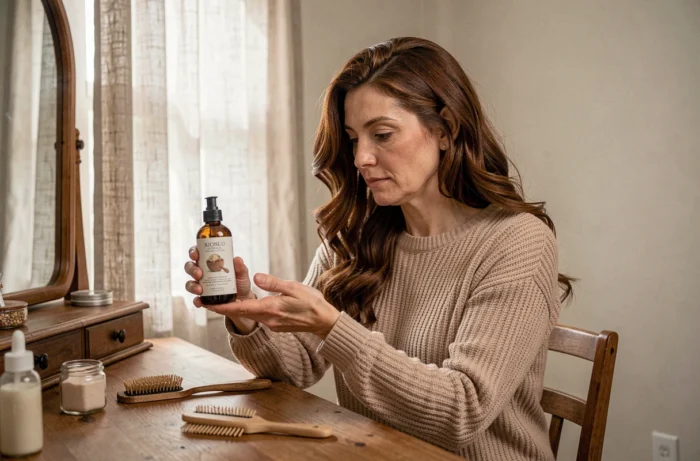
The legitimate use of Vermogal concerns the treatment of a confirmed lice infestation. Recent recommendations emphasize a often overlooked point: the presence of at least one living louse must be verified before starting treatment. Itching alone is not sufficient, as it can persist after the parasites have been eliminated or have a different cause (eczema, dryness).
Step-by-step application of Vermogal gel
The gel comes in a tube. The application follows a precise protocol to increase effectiveness while limiting irritation:
- Take a small amount of gel and dilute it in a little water to achieve a more fluid texture, making it easy to distribute on the roots.
- Apply only to the roots and scalp, section by section. A henna syringe allows for a more even distribution of the product.
- Leave on for at least two hours. Some users leave the product on overnight, but this extended duration increases the risk of skin irritation.
- Rinse thoroughly with lukewarm water, then proceed with a gentle shampoo to remove any residue.
The recommended frequency is one application per week at most. Multiplying applications of the same anti-parasitic product without reassessing the situation exposes one to two risks: scalp irritation and the development of resistance in lice.
Resistance to insecticides and treatment failure
Recent data report a documented resistance of certain lice populations to several insecticides, including permethrin and malathion. If no improvement is observed after two properly spaced applications, the product has likely lost its effectiveness on the relevant strain. Consulting a pharmacist to consider an alternative (dimethicone, occlusive mineral oil) is the appropriate course of action.
Precautions to ensure scalp health

Anti-parasitic treatments are not harmless for the skin. Vermogal, like any insecticide-based gel, can cause irritation, redness, or marked dryness of the scalp in cases of repeated or prolonged use. These precautions make regular cosmetic use incompatible with hair health.
Contact with the eyes is the most frequently reported risk. The gel should be applied while protecting the facial contours. In case of eye contact, immediate and prolonged rinsing with clear water is necessary.
Frequency and dosage: common mistakes
Using Vermogal daily in small amounts, without rinsing, is a practice circulated on some forums. This habit has no medical basis. An insecticide left permanently on the scalp weakens the skin barrier and can trigger contact dermatitis.
The dosage prescribed on the package corresponds to occasional use, not to a weekly beauty ritual. Adhering to the dosage limits adverse effects and preserves the product’s effectiveness for situations where it is truly needed.
Strong and shiny hair: what effective hair alternatives
To achieve truly stronger and shinier hair, the active ingredients to prioritize have nothing to do with an anti-parasitic. Recognized hair care products act on keratin, hydration, or nutrition of the hair bulb.
- Coconut oil penetrates the hair fiber and reduces protein loss. A mask applied before shampooing, once a week, is enough to enhance shine.
- Brewer’s yeast, rich in B vitamins and zinc, supports hair growth when taken in an oral course over several weeks.
- A gentle shampoo with an appropriate pH (slightly acidic) closes the hair cuticles and increases light reflection, giving an immediate shiny appearance.
These alternatives act on the very structure of the hair, where Vermogal acts on the parasites infesting it. The confusion between the two approaches leads to disappointments and avoidable irritations.
A healthy scalp naturally produces more resilient hair. Treating a parasitic infestation when it exists, then transitioning to care suited to hair health, remains the most coherent sequence. Vermogal has its place in the anti-parasitic kit, not in the daily beauty routine.