The cleanliness of professional spaces relies on technical choices that go beyond simply mopping the floor. Maintenance protocols, intervention frequencies, product selection: each decision influences indoor air quality, the durability of surfaces, and the health of occupants. Optimizing the cleanliness of your premises means structuring a reproducible method tailored to the actual constraints of each area.
PFAS Law and Professional Cleaning Products: What Changes in 2026
The PFAS Law No. 2025-188 of February 27, 2025 fundamentally reorganizes the list of authorized products in professional cleaning in France. Per- and polyfluoroalkyl substances, long used for their water-repellent and stain-resistant properties, are subject to a phased ban.
As of January 1, 2026, a first series of products containing PFAS is banned. By January 1, 2027, the ban extends to upholstered textiles, treated carpets, and fluorinated cleaning products. Specifically, this means the end of fluorinated degreasers, PFAS stain-resistant waxes, and water-repellent sprays for carpets, products that are still very common in office maintenance.
The key point for professional space managers: the contracting authority can now require a PFAS audit in their cleaning contract. This possibility changes the contractual relationship with service providers. Instead of undergoing a product change without visibility, you can impose a compliance clause right from the drafting of the specifications. The providers listed on the Horizon Net site allow for comparing service offers adapted to these new regulatory requirements.
By January 1, 2030, the law provides for a near-total ban on textiles containing PFAS, which will affect the choice of floor coverings in new or renovated premises.
Maintenance Protocol for Premises: Structuring Areas by Risk Level
An effective maintenance protocol does not treat all surfaces the same way. The method consists of classifying areas according to their level of use and health sensitivity, then assigning an appropriate frequency and technique to each.
Three Levels of Areas in a Professional Space
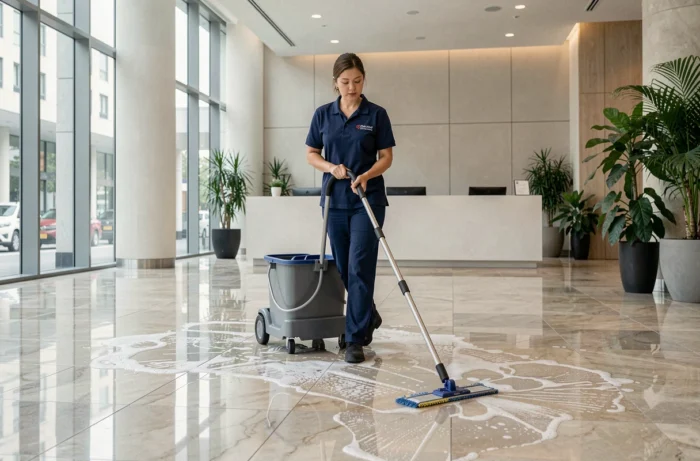
- High-traffic areas (reception, hallways, restrooms) require daily maintenance with detergent-disinfectant products. Restrooms concentrate the majority of pathogens and require a distinct protocol from the rest of the premises.
- Work areas (offices, meeting rooms) require regular but less intensive maintenance. Dusting high surfaces and cleaning contact points (handles, switches, keyboards) remain priorities.
- Technical or storage areas, less frequented, are subject to spaced but targeted interventions, particularly for waste management and ventilation.
This segmentation avoids wasting products on less used surfaces while concentrating efforts where health risks are real. It also facilitates monitoring: each area has its own traceability sheet, simplifying internal audits.
Frequency and Traceability of Interventions
A written, displayed, and updated maintenance schedule transforms cleaning into a verifiable process. Each intervention is time-stamped, noting the product used and the responsible agent. Traceability reduces oversights and facilitates the identification of dysfunctions when a cleanliness issue arises.
This system also allows for measuring the actual time spent per area, useful data for adjusting staffing or renegotiating a service contract.
Waste Management in Companies: An Underestimated Cleanliness Lever
The visible cleanliness of premises largely depends on waste flow management. A poorly placed sorting bin or an incoherent collection circuit generates overflow, odors, and rapid degradation of the work environment.
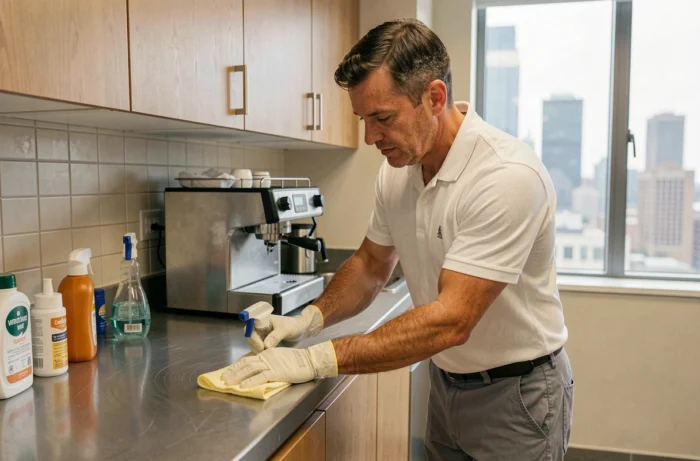
The principle is simple: bring collection points closer to waste production sites. In an open space, this means a sorting bin for each cluster of workstations, not just one container at the end of the hallway. In a shared kitchen, organic bins must be emptied at least once a day to prevent bacterial proliferation.
Team awareness plays a direct role. Clear signage on each bin (with visual examples of what goes where) significantly reduces sorting errors and overflow. This is not a secondary issue: a well-designed waste circuit decreases the overall cleaning time of the premises.
Certibiocide Certification and Selecting a Cleaning Service Provider
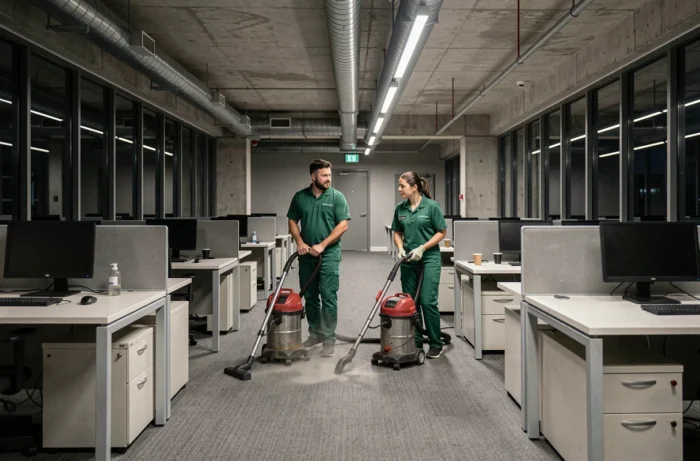
Since the strengthening of biocide regulations, cleaning companies that use disinfectant products must hold the Certibiocide certificate. This certificate certifies that the staff has been trained in the handling, dosing, and storage of biocidal products.
When choosing a cleaning service provider, checking the validity of the Certibiocide is not an administrative detail. Excessive dosing of disinfectant degrades surfaces, pollutes indoor air, and exposes occupants to respiratory irritations. Insufficient dosing does not disinfect.
Three concrete criteria can help differentiate providers:
- The possession of a valid Certibiocide for each agent working on-site
- The provision of a written protocol specifying the products used, their safety data sheets, and the dilutions applied
- The ability to adapt the specifications to regulatory changes, particularly the phased ban on PFAS in cleaning products
A provider who cannot provide these elements upon request poses a legal and health risk to the contracting authority.
Professional cleanliness is less about choosing a product brand than about the rigor of the applied protocol. The French regulatory framework is evolving rapidly, with concrete deadlines in 2027 and 2030 regarding PFAS. Integrating these constraints now into your contracts and maintenance practices is to avoid having to start from scratch in two years.