Measuring the effect of artistic creation or reading on social inclusion requires going beyond mere testimony. Several institutional frameworks are currently attempting to quantify these effects, from the summaries of the World Health Organization to national roadmaps on cultural accessibility. The challenge is to determine which workshop formats, which audiences, and which indicators produce documented results in terms of social connection, self-esteem, and mental health.
Compared intervention areas: literature, visual arts, and performing arts
Not all cultural inclusion projects are equal. Their effectiveness varies depending on the medium used, the target audience, and the duration of support. The table below summarizes the main differences observed in the documented programs.
| Criterion | Writing and reading workshops | Visual arts (painting, street art) | Performing arts (theater, puppetry) |
|---|---|---|---|
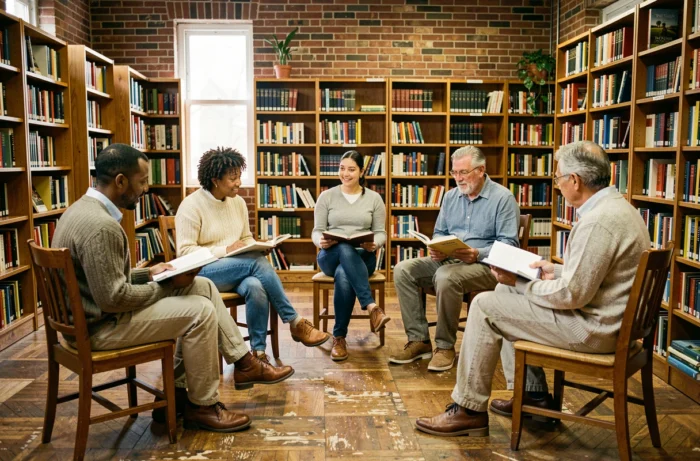
| Preferred audience | Isolated individuals, prisoners, non-French-speaking migrants | Young people struggling in school, individuals with disabilities | Adults with mental health issues, vulnerable adolescents |
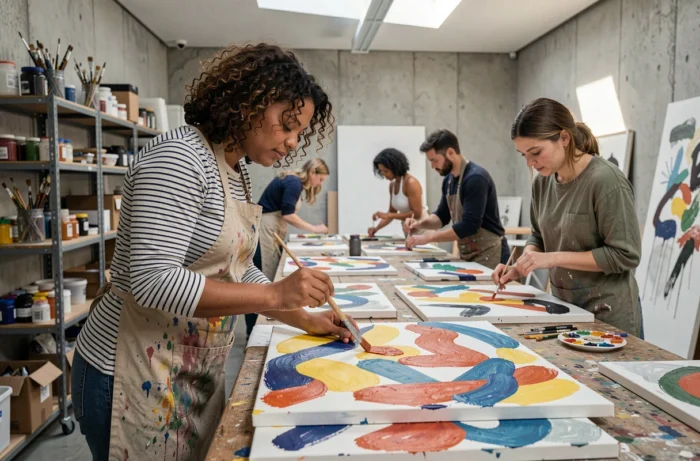
| Dominant format | Reading circles, small group creative writing workshops | Artist residencies, collective murals | Collective creation of a performance over several months |
| Measured inclusion indicator | Personal expression, language proficiency | Self-esteem, visibility in public space | Cooperation, sense of belonging to a group |
| Average duration of the program | Several weeks to several months | Variable (a collective mural can last a few days) | Several months of rehearsals and co-creation |
The ÉNAM (National School of Puppetry Learning) exemplifies the potential of the performing arts. Since 1990, it has offered around fifty adults suffering from mental health issues the opportunity to co-create a puppet show. Its approach intersects four areas (health, culture, education, work) within a unified framework, distinguishing it from one-off workshops.
Organizations like encrages.org specifically work at this intersection of literature, creation, and social connection, anchoring artistic practice in sustainable collective dynamics.
Mental health and artistic creation: what WHO summaries document
In 2019, a summary from the World Health Organization based on over 3,000 studies highlighted the positive effects of artistic activities on health and quality of life. This report remains the most cited reference for justifying the integration of artistic practice into public health policies.
The identified mechanisms involve the simultaneous mobilization of emotions, attention, and imagination. However, the summary emphasizes that effects vary significantly depending on the context: a two-hour isolated workshop does not produce the same results as a collective creation process spread over several months.
Social prescription and art therapy: a structural movement
A recent movement aims to integrate art therapy into primary care. A three-phase roadmap has been proposed:
- At 12 months: mapping existing initiatives, pilot workshops in hospitals, schools, and community centers, joint training for health professionals and artists, initial evaluations on well-being and social inclusion.
- At 24 months: territorial extension, integration of art therapy into primary care, consolidation of sustainable partnerships between culture, health, and environment.
- At 36 months: sustainability through durable funding models and integration into public policies.
This timeline shows that social prescription through art is moving beyond the experimental stage to enter a structured public policy framework.
Cultural accessibility and disability: the French roadmap
The French president unveiled a new roadmap in September 2026 to improve the daily lives of people with disabilities. Among the announced measures, several directly concern access to culture and creation:
- Accessibility objectives for library offerings, including adapted formats and public reception.
- Compliance of museums and heritage sites.
- National accessibility plan for cinemas for 2026-2029, with a significant increase in accessible screenings.
This articulation between disability, digital accessibility, and access to culture marks a shift in scale. Local initiatives for inclusive artistic workshops have existed for a long time. What is new is their incorporation into a national regulatory framework with specific deadlines.
Libraries and adapted formats: an underestimated angle
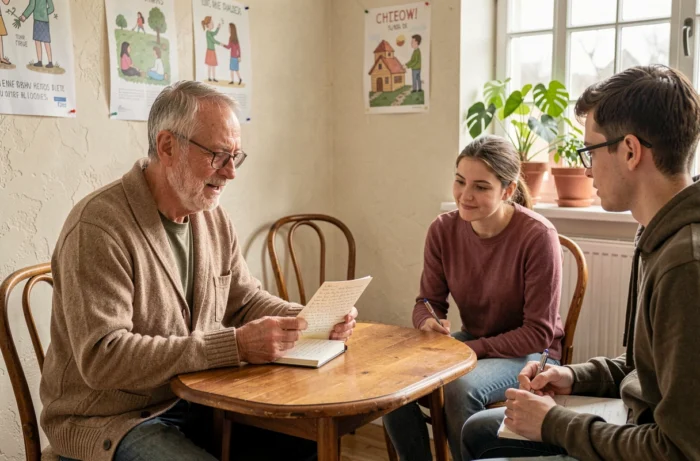
Literature as a vector for inclusion largely depends on libraries’ ability to offer accessible formats: audiobooks, large print, braille materials, simplified French collections for non-French-speaking audiences. The accessibility of libraries conditions the effectiveness of inclusion through reading.
The objectives set by the government roadmap specifically include welcoming individuals with disabilities in these establishments. Without this basic infrastructure, writing workshops or inclusive reading circles remain reserved for audiences already able to move and read standard formats.
Artist-educator partnership: a model that produces measurable results
The La Source Garouste network has been supporting young people aged 6 to 18 in situations of social, economic, or educational fragility for over thirty years. The principle is based on a artist-educator partnership that co-facilitates the workshops. The Orange Rouge association, for its part, has been organizing encounters between contemporary artists and adolescents aged 11 to 17 with disabilities for twenty years.
In both cases, the young people create works that are then presented to the public. This demonstration stage is crucial: it transforms the participant into an author, visible and recognized by an external gaze. The public presentation of the work changes the social status of the participant.
In contrast, programs that remain confined to the closed space of the workshop, without restitution or visibility, produce individual benefits (relaxation, expression) but few measurable effects on social inclusion in the strict sense.
The structuring data that emerges from all these programs is less about the choice of artistic medium than about two factors: the duration of support and the existence of a public restitution moment. A one-off workshop improves well-being. A collective creation process with a final presentation alters the social trajectory of the participant.