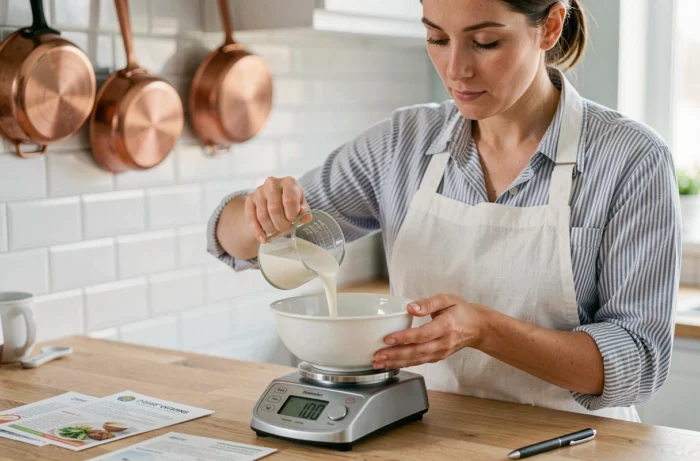
You are following a recipe that calls for 100 g of liquid cream, but your measuring cup only displays milliliters. The natural reflex would be to pour 100 ml and move on. This shortcut works with water. With cream, it introduces a subtle but sufficient difference to alter the texture of a ganache or the stability of whipped cream.
Why Liquid Cream Skews the Rule of “1 g = 1 ml”
For pure water, one gram occupies exactly one milliliter. This simple ratio comes from its density, set at 1. Liquid cream contains suspended fats, and lipids are lighter than water at equal volume.
The average density of whole liquid cream is around 0.97 grams per milliliter. This means that one milliliter of cream weighs slightly less than one milliliter of water. To obtain 100 g, you need to pour slightly more than 100 ml.
The calculation is straightforward: you divide the desired mass by the density. For 100 g of whole liquid cream, this results in about 103 ml. The difference seems small, but it accumulates when you double or triple the proportions of a recipe. To delve deeper into the conversion of 100g of cream to ml with other thick preparations like syrups, the principle remains the same: each liquid has its own density.
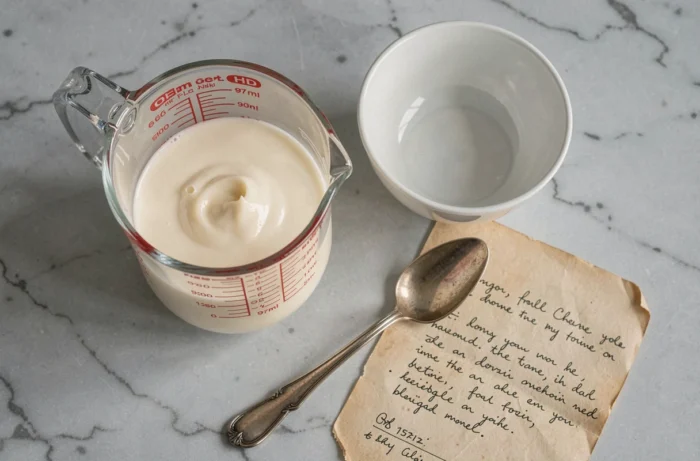
Variable Density Depending on the Type of Cream: The Fat Content Factor
Not all creams are equal on the scale. Have you noticed that a light cream flows more easily than a whole cream? This is precisely because their compositions differ, and so does their density.
The richer the cream is in fat, the lighter it is in volume. A low-fat fleurette cream has a density closer to 1. A thick cream with a high fat content strays further from this.
In practice, here’s what this means for 100 g of cream:
- A light liquid cream (about 15% fat) gives a volume very close to 100 ml, as its density is similar to that of water.
- A whole liquid cream (about 30% fat) requires about 103 ml to reach 100 g on the scale.
- A thick or double cream (40% and above) deviates even more: the necessary volume increases, as the density decreases with the concentration of lipids.
Generic conversion tables found online almost always ignore this distinction. They provide a single figure for “cream,” without specifying the type. When a pastry recipe calls for whole cream, using the ratio of a light cream alters the fat/liquid ratio of the preparation.
Read the Label to Find the Actual Density of Your Cream
The European regulation EU 1169/2011 requires manufacturers to display nutritional values for both 100 g and 100 ml on prepackaged products. This dual mention, rarely utilized in cooking, offers a reliable shortcut.
Concrete Method with the Label
Take your cream carton and locate the nutritional table. If the energy displayed for 100 g is different from that for 100 ml, the ratio between these two values gives you the density. Divide the “per 100 g” value by the “per 100 ml” value. The result usually falls between 0.95 and 1.
With this density in hand, converting any quantity from grams to milliliters becomes a simple division. No need to memorize tables: your packaging already contains the information.
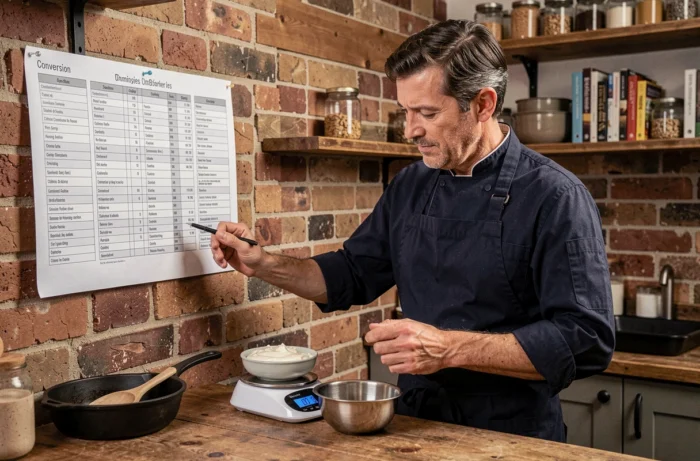
Converting Cream in Cooking: Spoons, Cups, and Measuring Cups
When you have neither a scale nor a graduated measuring cup in milliliters, everyday utensils take over. A tablespoon of cream weighs about 15 g. Therefore, you need just under seven to reach 100 g.
Why “just under” and not exactly seven? Because cream, especially thick cream, forms a dome above the spoon. A level spoon and a heaping spoon do not contain the same amount at all. To limit the error:
- Use level spoons, leveling off with the back of a knife.
- For thick cream, gently tap the spoon to remove trapped air bubbles.
- With a measuring cup, pour the cream at eye level: reading from above, the meniscus skews the measurement by a few milliliters.
The Anglo-Saxon “cup” format corresponds to about 240 ml. For whole cream, one cup therefore equals just under 240 g. Adapting American measurements without considering density systematically skews the proportions.
Recipes Where the Difference Really Matters
In soups or cream sauces, a few milliliters more or less go unnoticed. The margin of tolerance is wide. However, two types of preparations react poorly to approximations.
Ganache relies on a precise ratio between chocolate and cream. Too much liquid cream, even by a few grams, and the ganache won’t set properly. For ganache, always weigh the cream rather than measuring it by volume.
Whipped cream requires a minimal fat content to whip up. If you replace whole cream with light cream “while keeping the same volume,” the actual amount of fat decreases. The whisk turns, but the cream remains liquid.
The conversion from grams to milliliters for cream boils down to one action: check the type of cream used and adjust the volume according to its density. The nutritional label on your carton provides this information directly. For everyday recipes, the difference remains negligible. For pastry, a kitchen scale remains the most reliable way to obtain exactly the 100 g required.