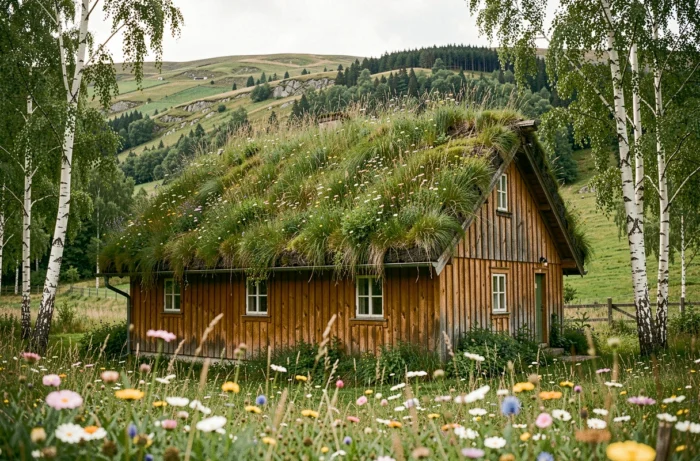
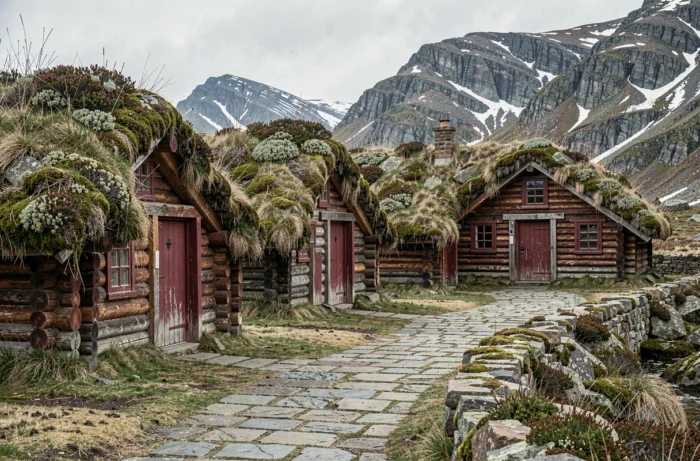
The torvtak, literally “turf roof” in Norwegian, refers to a roofing technique where several layers of soil and vegetation rest on a birch bark membrane placed on a wooden frame. This method, documented since prehistoric Scandinavia, remains visible on thousands of buildings in Norway, from mountain huts to contemporary residences.
Sámi Heritage and Prehistoric Roots of the Turf Roof
Articles dedicated to green roofs focus on the Norwegian peasant tradition. They overlook an entire aspect of this architecture: the Sámi culture of northern Scandinavia.
The gamme (in Norwegian) or goahti (in Sámi) are turf dwellings that date back to prehistoric times. These semi-buried structures, documented by heritage institutions in Northern Norway, use vegetated soil not only for roofing but also for walls, creating a complete thermal envelope.
The persistence of these two architectural lineages, peasant and Sámi, shows that the green roof is not just a picturesque motif. The traditional Norwegian grass-covered houses represent a shared construction knowledge among several Nordic cultures, each having adapted local materials (turf, birch bark, grasses) to their own climatic and geographical constraints.
This dual lineage explains the density of torvtak in very different areas of the country: the Western fjords, the Hardangervidda plateaus, and the Arctic regions of Finnmark. The principle remains the same, but the plant species and substrate thickness vary according to altitude and latitude.
Snow Load and TEK17 Standard: Technical Constraints of the Torvtak
The visual charm of green roofs obscures a mechanical reality. A roof covered with soil and grass weighs significantly more than a roof made of tiles or metal. When snow accumulates on it for several months, the total load becomes a critical design parameter.
The Norwegian building code TEK17 sets variable snow loads according to the region. Coastal areas in the south receive less snow than inland valleys or high plateaus, and structural requirements differ accordingly. Any new construction or major renovation must comply with these thresholds, including mountain cabins that adopt the tradition of torvtak.
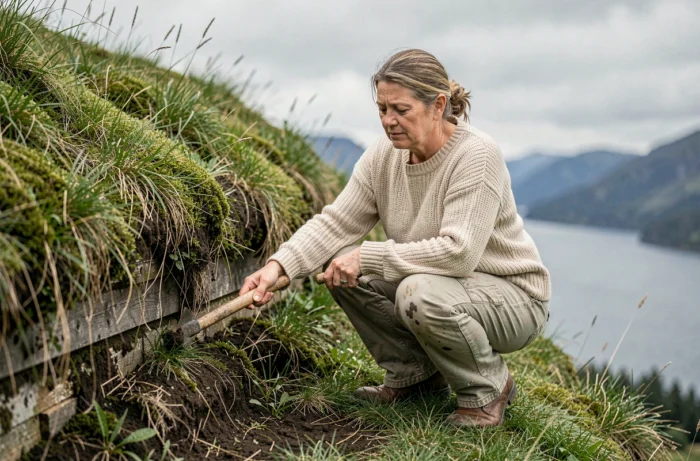
Winter maintenance poses a specific problem. Traditional snow removal methods (ropes, metal scrapers) risk tearing the vegetation layer or puncturing the birch bark waterproofing membrane. Norwegian technical resources recommend gentle snow removal techniques to preserve both the vegetation and the roof’s waterproofing.
- Mechanical scraping is discouraged: it degrades the root layer that ensures the cohesion of the substrate.
- Partial shoveling (leaving a residual layer of snow) protects the vegetation from direct frost while limiting the overload.
- The slope of the roof, generally low on traditional torvtak, must be calibrated to promote natural sliding without carrying away the substrate.
This interplay between constructive tradition and contemporary regulatory requirements constitutes one of the least documented technical challenges of the torvtak. A green roof compliant with TEK17 requires an adapted frame calculation, not a simple reproduction of the old model.
Thermal Performance and Microclimate of Scandinavian Green Roofs
The thermal argument appears in all tourist descriptions: the green roof “insulates from the cold in winter and from the heat in summer.” The physical reality deserves clarification.
The layer of earthy substrate functions as a thermal mass. It slows the penetration of outside cold into the interior, and vice versa. In summer, the evapotranspiration of grasses cools the roof surface. The buffering effect reduces temperature fluctuations between day and night inside the building.
Recent research conducted at the Technical University of Braunschweig on the micrometeorology of green roofs confirms that small-scale measurement methods (flux sensors, temperature probes in the substrate) can be extrapolated to assess energy performance at the building scale. These studies, although focused on urban green roofs in Central Europe, validate the physical principles empirically exploited by Scandinavian builders for centuries.
The birch bark membrane plays a complementary role. It ensures waterproofing while remaining permeable to water vapor, limiting condensation in the frame. Modern constructions sometimes replace the bark with synthetic membranes, but the principle of hygroscopic management remains the same.
Green Roofs in Norway Today: Tourism, Heritage, and Contemporary Architecture
The torvtak is not fixed in a museum role. Contemporary Norwegian architects integrate it into new projects, from hiking huts in the DNT network to high-end private residences.
Several factors explain this persistence:
- Landscape integration: a green roof blends into the surrounding vegetation, a criterion increasingly valued by urban planning regulations in protected areas.
- Heritage dimension: Norwegian cultural authorities support the restoration of historic torvtak, maintaining a network of artisans specialized in turf installation.
- Tourist appeal: grass-roofed cabins and huts constitute a recognized photographic motif, fueling Norway’s image as a destination for preserved landscapes.
- Environmental performance: a green roof absorbs rainwater and reduces runoff, a concrete advantage in the high rainfall regions of the west coast.
Traveling in Norway offers a rare opportunity to observe this technique on buildings in actual use, not just in open-air museums. From the Lofoten Islands to the valleys of Telemark, the torvtak is part of the inhabited landscape.
The lasting allure of these roofs lies in a rare balance in architecture: a millennia-old technical solution that addresses, without major adaptation, current concerns of insulation, water management, and integration into the natural landscape.