The offer of sports for toddlers has been structured in recent years around disciplines such as baby gym, baby swimming, or baby yoga. At the same time, French public policies are changing the landscape of motor skills development: the 30 minutes of daily physical activity program, implemented in primary schools since the start of the 2024 school year, including in kindergartens, now incorporates motor games and obstacle courses from cycle 1. The environment in which a child develops their motor skills is no longer limited to clubs and associations.
Physical activity for toddlers: what schools are already providing
Parents looking for a sport for their two or three-year-old sometimes overlook that kindergarten already offers a structured foundation for motor skills development. The educational resources provided by Eduscol for cycles 1 and 2 include motor skills courses, balance games, and coordination activities supervised by teachers.
This reality changes the initial question. Club sports do not fill a void; they complement work already started during the day. Seeking a sports activity for a toddler then involves identifying what the school does not cover: the aquatic environment, the parent-child relationship in physical effort, or specific sensory stimulations.
Organizations like Baby Sport specifically offer sessions designed for this complementary niche, with courses adapted for children as soon as they can walk, supervised by early childhood educators.
Baby gym and motor skills courses: what this discipline really works on
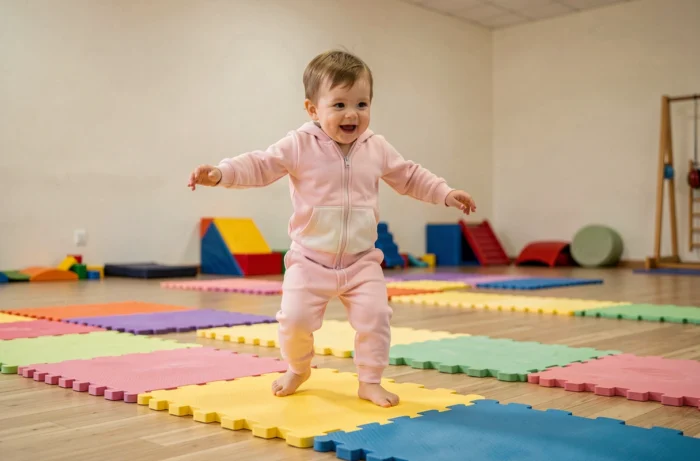
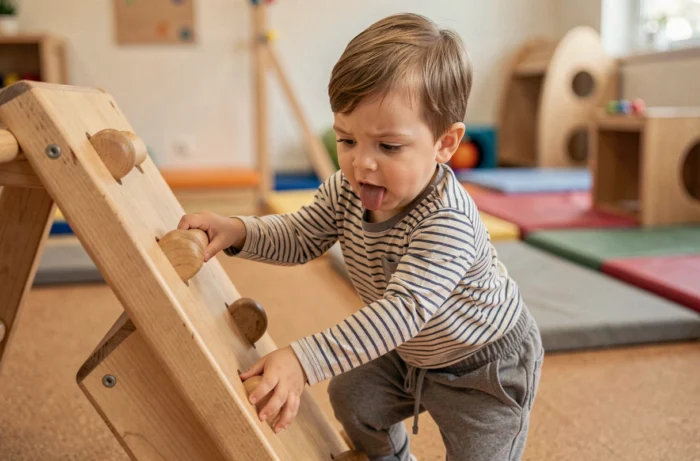
Baby gym remains the most widespread discipline for children aged one to three years. The sessions are based on modular motor skills courses (low beams, tunnels, inclined planes, mats) and engage balance, coordination, and proprioception.
What distinguishes a good baby gym session from simple free play is the progression of the course. A trained educator adjusts the difficulty to the observed motor skills: a child who has just started walking does not overcome the same obstacles as a thirty-month-old child who runs and jumps.
Feedback from the field diverges on one point: the presence of the parent during the session. Some organizations require systematic accompaniment, while others offer independent slots starting at two years. Both approaches have their logic.
- With the parent, the child gains confidence, and the duo works on body communication, which strengthens the emotional bond around physical effort.
- Without the parent, the child more quickly develops their ability to interact with other children and manage frustration in the face of an obstacle.
- Mixed sessions, where the parent gradually steps away over the weeks, seem to offer a smoother transition to motor independence.
Baby swimmers and aquatic awakening: an environment that schools do not replicate
Water provides a sensory environment that is radically different from the ground. Buoyancy alters support, the resistance of the water slows movements, and allows the child to perceive their body differently. This is precisely what land-based activities in gyms or classrooms do not replicate.
Baby swimming sessions are generally accessible from four to six months, provided the child has received their first vaccinations. The goal is not to teach swimming, but to familiarize the child with the aquatic environment while stimulating their overall motor skills: leg kicks, short immersions, movements with support from the parent.
A often overlooked point concerns the water temperature. Pools that host baby swimmers maintain warmer water than standard pools, which reduces the risk of cooling but also implies higher operating costs for the facility. The available data does not allow for a conclusion on whether the scarcity of slots in certain cities is due to this additional cost or a lack of demand.
Pass’Sport and financial access to motor skills activities
The Pass’Sport, a 50 euro aid per child for registration in a sports club or association, has been renewed for the 2026 campaign. This aid, available from September 1 to December 31, targets a wide audience of minors, including children of baby gym or baby sport age.
This measure effectively reduces the financial barrier. An annual fee for associative baby gym often falls within a modest range, and the Pass’Sport can cover a significant part of it. For families who are hesitating between several activities, this aid makes it possible to try out an activity without a heavy financial commitment.
The process is done online or directly with the club, which deducts the amount of the aid at the time of registration. Structures affiliated with recognized sports federations (such as the French Gymnastics Federation for baby gym) are eligible.
Choosing a motor skills sport: the criteria that matter before the discipline
The choice between baby gym, aquatic awakening, or baby yoga matters less than three concrete parameters that are rarely highlighted.
- The qualification of the instructor: a qualified sports educator or a psychomotor therapist does not offer the same type of session. The former structures a physical course, while the latter observes the child’s overall development and adjusts the stimulations accordingly.
- The child/adult ratio: below six children per instructor (excluding parents), the session remains individualized. Beyond that, it becomes a collective time where personalized observation disappears.
- Regularity: a regular weekly session produces more effects than a one-off intensive course on a toddler’s coordination and balance.
The discipline itself matters less than the quality of the supervision and the consistency of the practice. A child who participates in baby gym every week in an appropriate setting progresses more than a child enrolled in three different activities without regularity.
The landscape of motor skills development in France now combines school programs, public aids such as Pass’Sport, and associative or private offerings. Before choosing a sport for a toddler, checking what the school already offers and ensuring that the instructor is trained in early childhood remains the most reliable starting point.