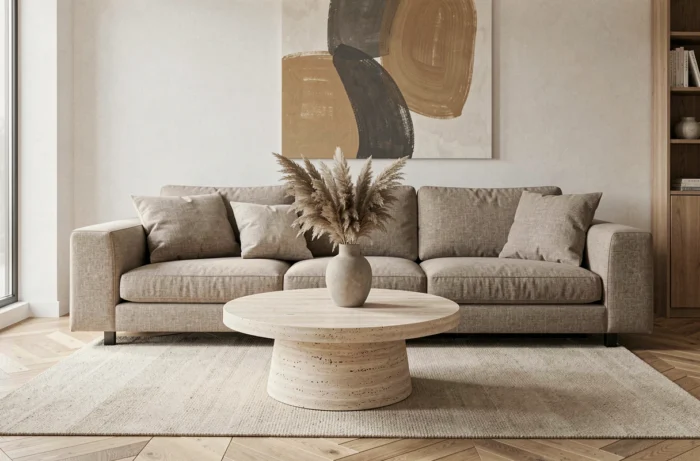
Modern decoration is no longer limited to sleek furniture placed on a polished concrete floor. The trends for 2025-2026 shake up this interpretation by reintroducing vintage pieces, warm color palettes, and a more structured maximalism. To enhance your interior with modern decoration, it is now essential to master precise technical trade-offs between materials, proportions, and light sources.
Proportion of raw materials in a modern interior
A design interior relies on a controlled ratio between smooth surfaces and organic textures. We recommend limiting lacquered surfaces (furniture, backsplashes) to one-third of the visible surfaces in a room, with the rest allocated to living materials: solid wood, natural stone, crumpled linen, artisanal glazed ceramics.
This balance prevents the “showroom” effect produced by interiors saturated with uniform surfaces. Textured wallpaper, for example, plays a structuring role when applied to a single wall, facing the entrance of the room. It creates a focal point without weighing down the volume.
The floor deserves special attention. Wide plank flooring (oak or walnut) provides a warm visual base that large-format tiles do not replicate. In renovations, laying high-end laminate flooring with a pronounced bevel remains an acceptable technical compromise, provided a matte finish is chosen – never glossy.
Several furniture and finish catalogs, such as those offered on arno-deco.be, allow for comparison of the finishes between wood species and contemporary finishes before making a decision.
Warm and deep colors: replacing cold gray in interior decoration
The omnipresent anthracite gray of the past decade is giving way. Trend analyses for 2026, including the 1stDibs Designer Trends Survey, confirm a clear shift towards chocolate browns, deep terracottas, and so-called “earthy” palettes. This change is not merely cosmetic: it alters the thermal perception of a space.
A wall painted in warm brown absorbs light differently than a gray wall. Matte paint enhances this effect by eliminating distracting reflections. For a north-facing room, we favor a medium terracotta tone that compensates for the bluish cast of natural light.
Combining deep colors with light decorative objects
The classic trap is to darken the entire room. The operational rule is: deep colors on fixed surfaces, light tones on movable objects. Ecru linen cushions, white ceramics, and brushed brass lighting create breathing points that prevent the space from visually closing in.
A framed wall art with a light mat amplifies this contrast effect. It is better to have a single large canvas than an accumulation of small frames, which fragments the gaze in a room with dark walls.
Structured maximalism: mixing vintage and contemporary design
Maximalism is back, but in a more disciplined form than in the early 2010s. The 1stDibs Designer Trends Survey notes that professionals are now combining antique pieces and current furniture in the same project, with increasingly frequent local sourcing.
In practical terms, this means integrating a vintage chair from the 1960s into a living room with a contemporary sofa. Cohesion comes not from style but from the palette: if the two pieces share the same color range (warm neutral tones, for example), the whole holds together.
- A vintage dark walnut sideboard visually anchors a dining corner, even in front of contemporary tubular metal chairs
- Period lighting (opaline wall sconces, patinated brass pendants) brings a historical depth that new reproductions cannot replicate
- Antique textiles (kilims, raw wool throws) serve as a binding element between furniture from different eras, provided they remain within a limited color range
Integrated storage to contain maximalism
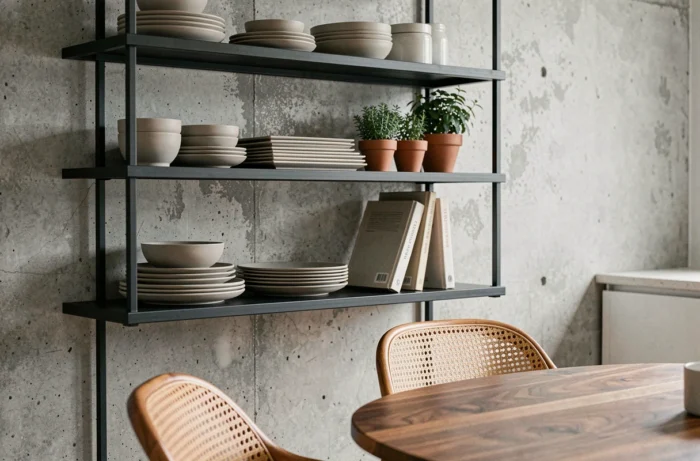
Without thoughtfully planned storage, maximalism becomes chaos. Built-in wall niches, full-height bookshelves, and closed low furniture absorb the mass of decorative objects without cluttering the living space. The rule we apply is: for every exposed object, three objects should be stored away.
This ratio maintains the visual density of the style while preserving circulation in the room. Open storage (shelf units without backs) only works if each shelf is composed with a vertical and horizontal rhythm, like a bookstore display.
Layered lighting: the technique that transforms home decoration
A single ceiling light kills any decorative effort. Modern decoration relies on three layers of overlapping lighting: ambient light (pendant or dimmable ceiling light), functional light (desk lamp, reading light), accent light (adjustable spotlights, recessed LED strips).
The color temperature plays a technical role that is often overlooked. In a warm-toned living room, a bulb above 3,000 kelvins pulls the ambiance towards the cold and negates the chromatic work of the walls. We recommend staying between 2,700 and 3,000 K for living spaces, reserving higher temperatures for work areas.
- Wall dimmers allow for transitioning from functional lighting to a dimmed ambiance without changing bulbs
- A recessed LED strip placed under a low piece of furniture creates a floating effect that visually lightens heavy volumes
- Table lamps made of blown glass or artisanal ceramics function as decorative objects in their own right, even when turned off
Modern decoration as practiced in 2026 requires less adherence to a single trend than to master the articulation between materials, colors, and light. A successful interior is recognized by its technical coherence, not by the sum of its decorative pieces.