
What information must a home coaching website display to comply with French law? Between legal notices, GDPR compliance, and new electronic invoicing rules that came into effect in September 2026, the obligations overlap. This article measures the gap between what most coaching websites display and what the regulations actually require.
Electronic Invoicing 2026: What Changes for a Home Fitness Coach
Most guides on creating a coaching website stop at legal notices and terms of use. They overlook a recent obligation that directly concerns coaches, including those in micro-enterprises.
Since September 1, 2026, any business subject to VAT must be able to receive electronic invoices via an approved platform. Home fitness coaches working with individuals are not exempt from this obligation to receive.
From September 1, 2027, these same professionals will have to issue structured electronic invoices (Factur-X, UBL, or CII formats) for their professional clients: businesses, works councils, local authorities. They will also need to perform e-reporting of their sales data, including those made to individuals.
A home coaching website that offers sessions to professional clients should therefore mention the invoicing platform used and the data retention methods associated with it. This point is absent from almost all current websites.
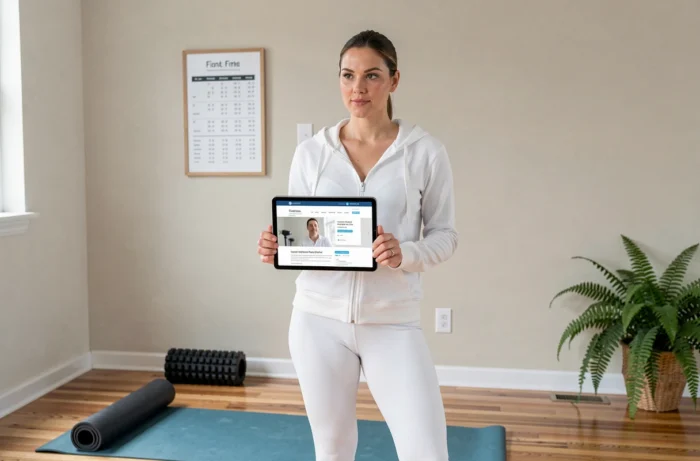
The presentation of the site Mon Coach A Domicile illustrates how to structure a legal notice page that incorporates this information in a readable manner, beyond simply copying and pasting generic templates.
Legal Notices, Terms of Use, and Privacy Policy: Comparative Table of Obligations
Three distinct legal documents must appear on any professional coaching website. Their content and function do not overlap, but many coaches confuse them or omit one.
| Document | Main Content | Legal Basis | Sanction for Absence |
|---|---|---|---|
| Legal Notices | Identity of the publisher (name, SIRET, address), website host, publication director | Law for Confidence in the Digital Economy (LCEN) | Up to 75,000 euros fine for individuals |
| Terms of Use (CGU) | Rules for using the site, limitation of liability, intellectual property | Civil Code (contractual obligations) | No direct sanction, but absence of a framework in case of dispute |
| Privacy Policy | Types of data collected, purposes, retention period, user rights | GDPR (European Regulation 2016/679) | Up to 4% of global annual turnover |
For a self-employed fitness coach, the legal notices remain the most scrutinized document. The absence of a SIRET number or professional address is the most common violation found on home coaching websites.
GDPR Compliance of a Coaching Website: Concrete Pitfalls
A coaching website collects personal data as soon as it offers a contact form, a booking calendar for sessions, or a newsletter subscription. The GDPR then imposes several specific mechanisms.
- The cookie consent banner must allow for a refusal as simple as acceptance. A visible “Accept” button and a “Settings” link in small print do not meet this requirement.
- Each form must state the purpose of the processing, the data retention period, and the right to rectification or deletion. A simple “your data is protected” is not enough.
- If the coach uses a third-party tool (booking platform, emailing software), the privacy policy must name these subcontractors and specify any data transfers outside the European Union.
A micro-enterprise coach is subject to the same GDPR rules as a large company. The legal status does not change the level of requirement regarding personal data protection.

Special Case: Home Fitness Sessions and Health Data
When a home fitness coach collects information about their clients’ physical condition (injuries, pathologies, rehabilitation goals), this data falls into the category of health data under the GDPR. Its processing requires explicit and separate consent, and its storage must be subject to enhanced security measures.
Few coaching websites mention this point. An online health questionnaire, for example, should be accompanied by a specific consent box, separate from the general consent to the terms of use.
Professional Status and Information to Display According to Legal Structure
The exact content of the legal notices varies depending on whether the coach operates as a micro-enterprise, SASU, or EURL. The differences concern specific elements.
- A self-employed fitness coach must indicate their name, SIRET number, and registered address. They do not have an RCS number unless they voluntarily register with the commercial register.
- A SASU or EURL must add the amount of share capital, RCS number, registered office, and name of the legal representative.
- A coach registered in personal services (SAP) must mention their approval or declaration number, as this information conditions the 50% tax credit for the client.
- If the coach holds a professional sports educator card, their card number must appear on the site. This obligation arises from the Sports Code.
Omitting the SAP declaration number deprives clients of the ability to verify their eligibility for the tax credit, which represents both a commercial hindrance and an administrative failure.
The overlap of these obligations—legal notices LCEN, GDPR compliance, SAP declaration, professional card, and now electronic invoicing—makes the legal framework of a home coaching website denser than it appears. The starting point remains the same: each legal page must reflect the reality of the activity carried out, not a generic model downloaded online.